What I do
Diligence work for investors ends in a report like this one: an investor's question about a magnet or rare-earth company, answered step by step by someone who has run the steps.
I read the data room, walk the plant, and talk to the people who run it. Then I grade every step of the process for how ready it really is, weigh the team against the plan, map where the materials come from, and set out the strengths and weaknesses plainly, along with what would change my view. The investment decision stays with the client, where it belongs.
Real reports belong to the clients who paid for them, so here is a complete one about a company that does not exist.
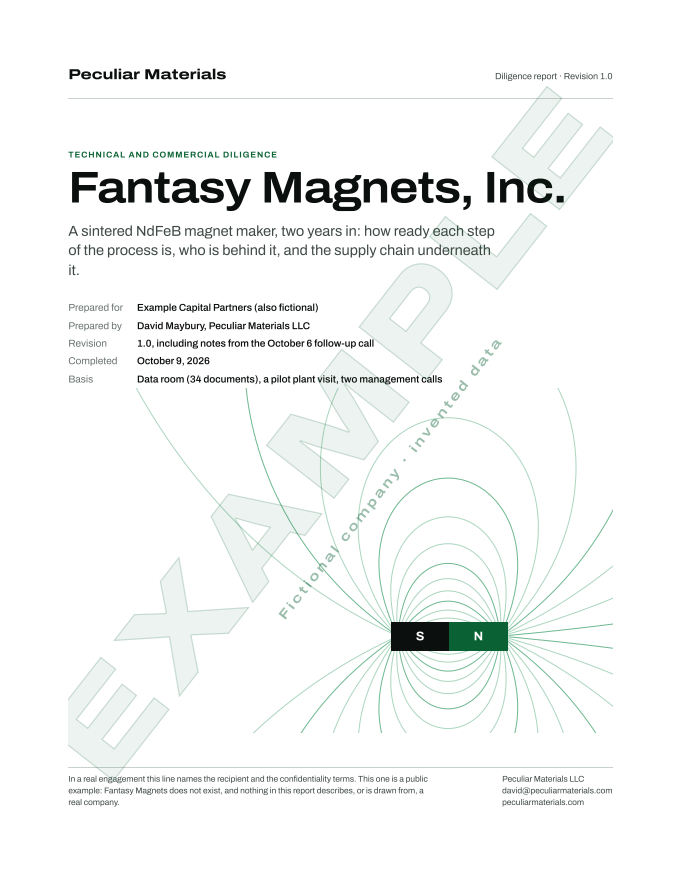 Fantasy Magnets, Inc. Revision 1.0
Fantasy Magnets is fictional. So are its people, investors, suppliers and customers, and every number, chart and curve in the report. Nothing in it describes or is drawn from a real company or a real engagement, and every page says so.
What is in a report
The example is a powder-metallurgy startup with a brilliant chief technology officer, a strong powder line, and three process steps nobody on the team has done before, sitting on a supply chain with more single points of failure than its plan admits. The structure is the same for every engagement.
The assessment, first
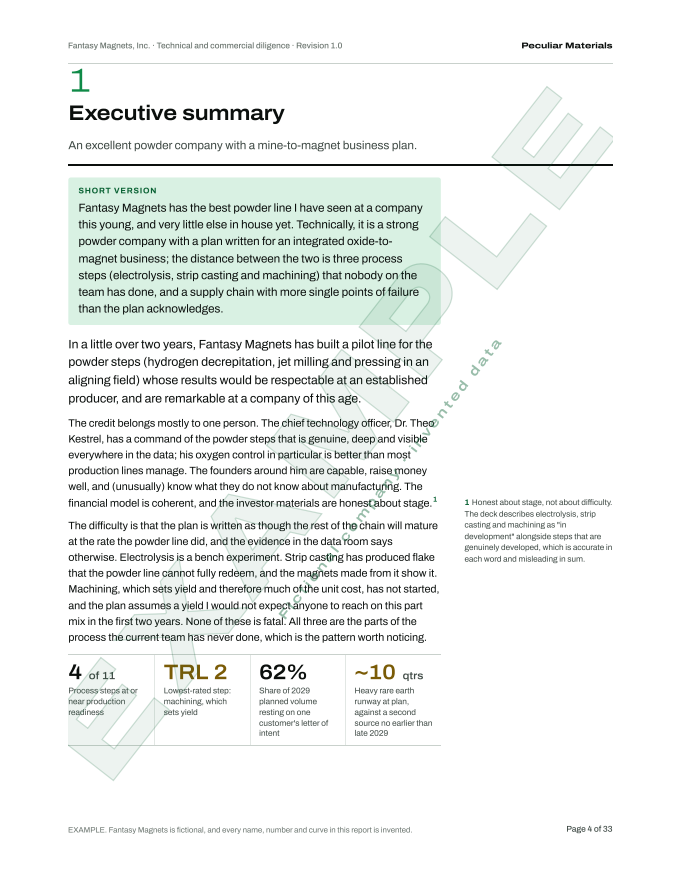
Two pages: what is good, where the risk sits, and the gaps that matter most.
Chapter 1
Every step graded
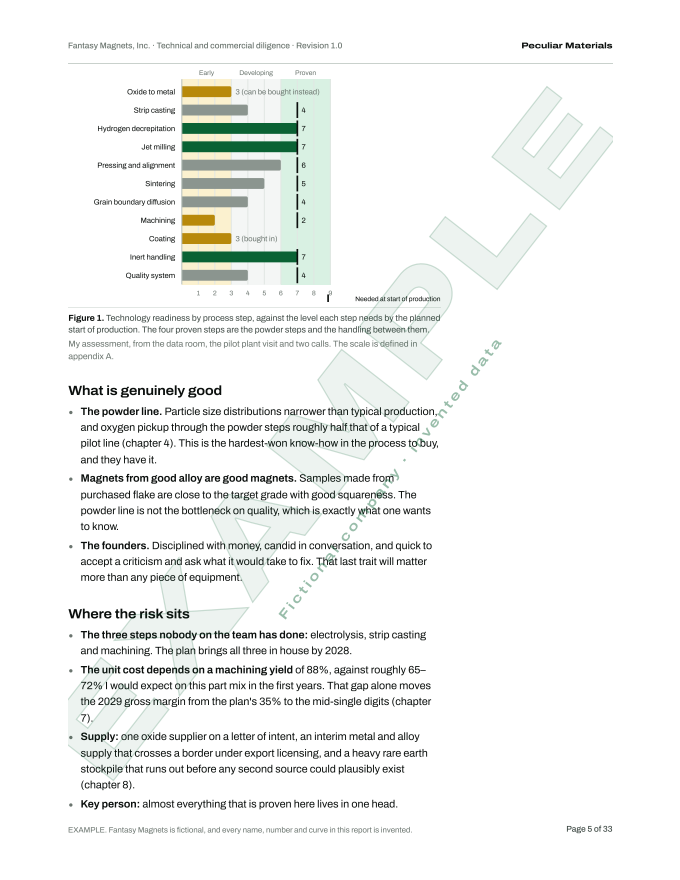
Readiness by process step on a nine-level scale, never pass or fail, against what the plan needs and when.
Chapters 1 and 4
The team, against the plan
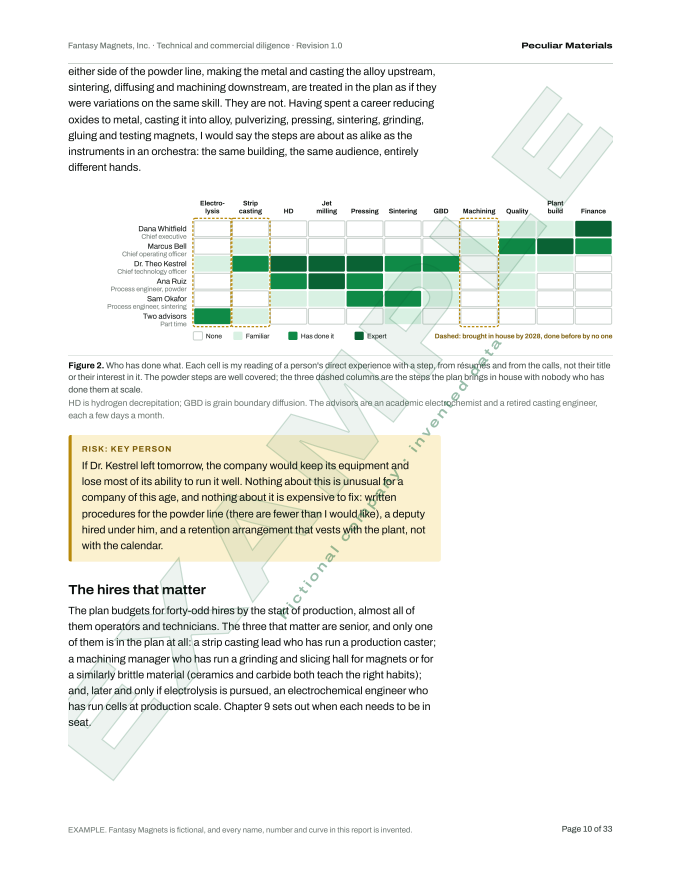
Who has actually done each step, and which steps the plan brings in house with nobody who has.
Chapter 3
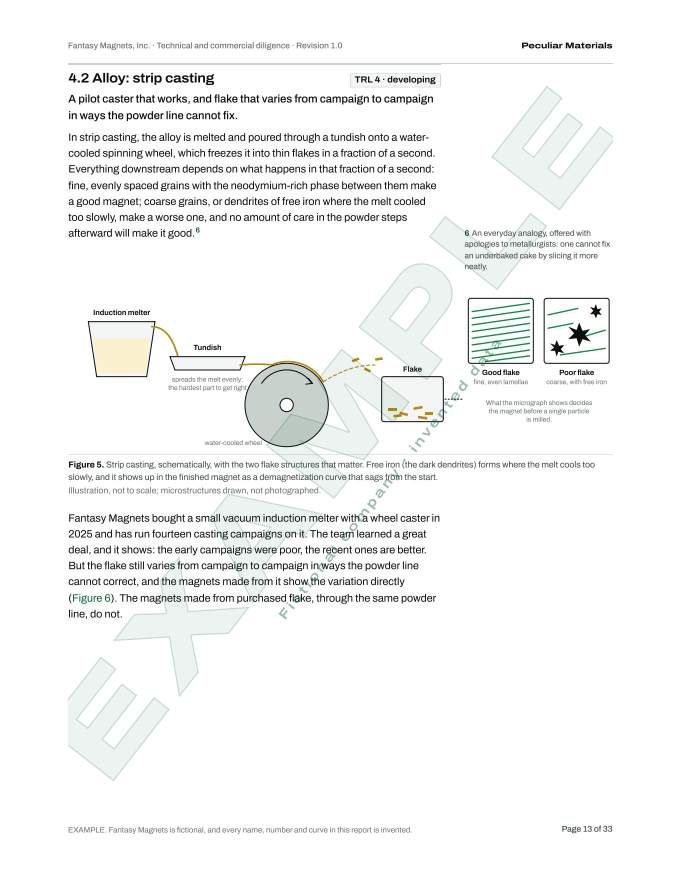
The process, drawn
Each step explained, with what the data room shows, what it leaves out, and notes from the calls.
Chapter 4
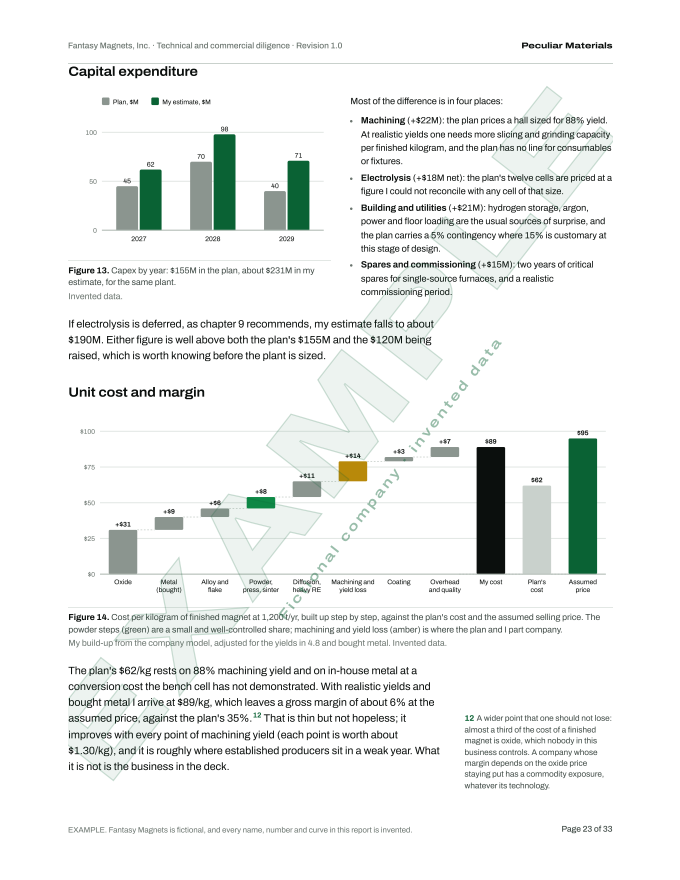
Where the money goes
The ramp, the capex and the unit cost rebuilt from the plant floor up, and the one assumption that moves the margin most.
Chapter 7
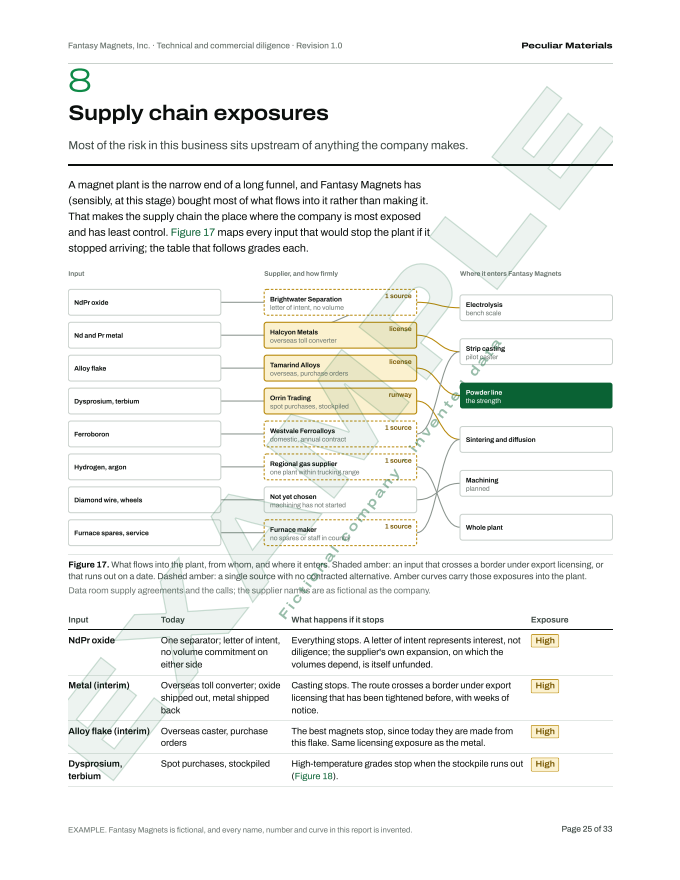
Every input, and who supplies it
Single sources, border crossings and stockpiles that run out on a date, with what happens when each one stops.
Chapter 8
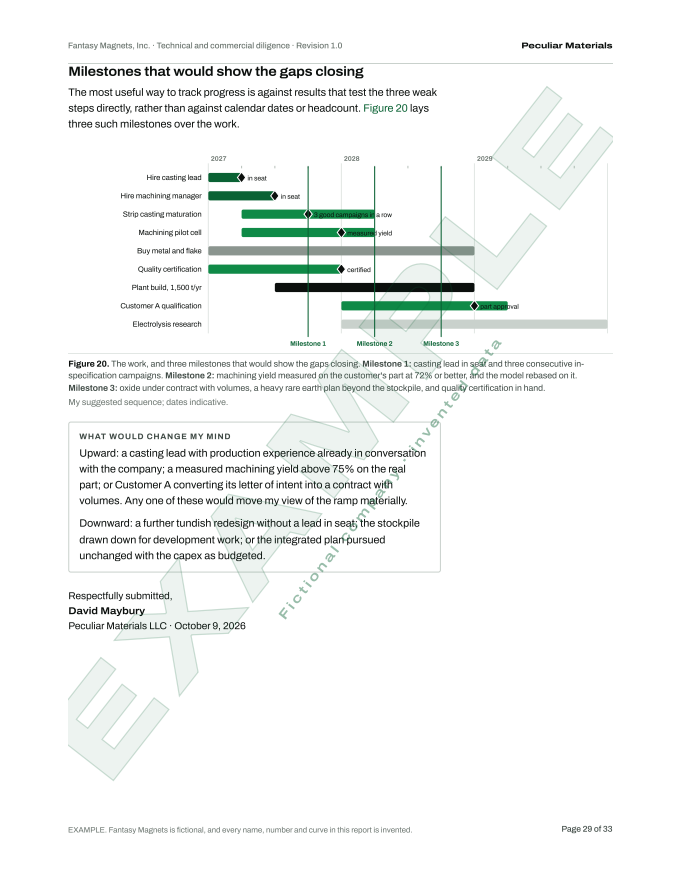
What would close the gaps
Hires, process changes, and milestones that test the weak steps directly, rather than the calendar.
Chapter 9
How an engagement runs
Each report is written for the decision in front of the client, so the scope is agreed first and the length follows from it.
Scope
A call to agree the question, the deadline, and what the decision on the other side of the report is.
The data room
Every document read against every other. A claim counts for little until a run log or a measurement supports it.
The plant and the people
A walk through the line and calls with the team. What a presentation does not discuss is often the finding.
A draft, with questions
The assessment up front and the argument behind it, with the open questions listed rather than guessed at.
Follow-up, dated in place
New evidence from a follow-up call goes in as a dated note, so the client can see what changed my mind and why.
And when it is not diligence
The same knowledge, pointed the other way: at building a plant or buying from one.
Magnetics and magnet manufacturing
Grade selection, thermal limits, and process engineering for sintered NdFeB and SmCo: plant design, equipment selection, ramp-up, yield and scrap.
Rare-earth supply chains
Sourcing strategy from oxide through metal, alloy and finished magnet, supplier qualification, and what export controls mean for a program.
Free, on this site
The Insights explainers, the calculators, and a weekly Digest of the news that matters in magnets.
Evaluating a magnet or rare-earth company, or building one? Tell me what the decision is.
Email David