Short versionThe lanthanides all carry the same charge and shrink by a few tenths of a percent, one at a time, across the row. That is the entire handle you get. And the hardest split of all is one a magnet maker does not need to make.
01 · The problemThe fraternal fifteen
Why rare earths are hard to separate, and which splits actually matter.
Lanthanum through lutetium is a run of fifteen elements that fill an inner electron shell while the outer shell, the one that does the chemistry, stays the same. So in solution they all show up as the same +3 ion and they all do the same things. The one steady difference is size: each element is slightly smaller than the one before it. Chemists call it the lanthanide contraction, and it is the only lever anyone has ever found.
Ore does not care about any of this. A bastnaesite or monazite concentrate carries all fifteen together, and the ones a magnet maker wants sit in two adjacent pairs: neodymium and praseodymium, which make the magnet, and dysprosium and terbium, which let it survive heat. Neighbors are the hardest pairs to split. Here is the part that surprises people: you mostly do not split them. Neodymium and praseodymium are close enough to magnetically identical that the industry leaves them together and sells the mixture as NdPr oxide, and the magnet comes out the same.1 The job is not to separate fifteen elements. It is to pull two pairs cleanly out of the other eleven.
Short versionOne contact between two phases moves the mix by a few percent. Purity comes from repeating that contact until the few percent compounds into a clean split.
02 · The problemThe separation factor
The number every method is built around.
Put a mixed rare-earth solution in contact with something that prefers heavier lanthanides a little more than lighter ones, and the heavier elements move across a little more readily. The ratio of how much more is the separation factor. For the neodymium-praseodymium pair on the industry's standard extractant it is about 1.4, and lower still in some chemistries.2 A separation factor of 1.4 means one contact turns a 50/50 mix into roughly 54/46.3 That is the split nobody bothers with, and it shows why: the number of contacts needed is set by the separation factor, and the pairs you would least like to separate are the pairs with the smallest factors.
That is the whole game. No single contact gets you anywhere near 99%. Every separation strategy is a way of stacking small preferences, and the two strategies on this page differ almost entirely in HOW they stack. Chromatography, which came first, stacks them in time, as a band creeps down a column and re-equilibrates with every bead it passes. Solvent extraction, which came second and won, stacks them in space, one vessel per contact. The rest of the page tells that story in the order it happened.
Short versionThe first pure lanthanides came off an ion-exchange column at Ames Laboratory in 1947. The rare earths stick to resin beads; the trick is in how you make them let go.
03 · 1947: chromatography firstThe column
Where the story starts.
The first successful separations of rare earths from one another were published in November 1947, from Ames Laboratory in Iowa and Oak Ridge in Tennessee, and they were done on ion-exchange columns.4 Before that, the elements had been pulled apart by fractional crystallization, which took years per element and is how most of them were discovered. The column was a revelation, and it is worth understanding exactly what it did, because the 2020s revival is the same device.
A column is packed with fine resin beads whose surfaces carry acid groups. Pump the mixed rare-earth solution through and the +3 ions swap onto the beads, displacing the hydrogen or ammonium ions that were there. At this point the column has done nothing selective. All fifteen elements are sitting in a band at the top, in whatever ratio the feed had, because the beads cannot tell them apart. The selectivity comes from a ligand: a chelating molecule dissolved in water, citrate in 1947 and EDTA (ethylenediaminetetraacetic acid) soon after, that binds rare-earth ions with a strength that rises steadily across the row. Same lever, the lanthanide contraction, pulling from the other direction: the heavy ions prefer the solution and the light ions prefer the bead.
Short versionPush the band down the column with ligand and it sorts itself into a train of pure zones, heaviest first, with a thin mixed zone between each pair.
04 · 1947: chromatography firstThe train
Displacement, and why the zones sharpen instead of smearing.
The ligand solution is pumped in behind the band. Wherever it meets rare earth on a bead, it competes for the ion. The heavy ions, which bind the ligand most strongly, are lifted off first and carried a little way down the column before they swap back onto fresh beads; the light ions, which bind least, are left behind. Every bead the band passes is a fresh contact. The band pulls apart into a sequence of zones, one element each, all marching down the column at the same speed. The literature calls it an isotachic train, which is just Greek for "same speed."
The clever part is that displacement is self-sharpening. A heavy ion that lags into the zone behind it finds itself among ions it can displace, and gets pushed forward again; a light ion that runs ahead gets displaced back. The mixed zones between pure zones stay thin instead of spreading, which is what an ordinary elution would do. At the bottom, the outlet is switched between product tanks as each zone arrives. The mixed zones go to a recycle tank, and how thin they are is most of the yield.
Short versionA column is a cascade folded up. The beads offer far more contact surface per cubic meter than an emulsion does, so one column stands in for a long row of tanks. That was true in 1947 and it is the whole reason we are still talking about it.
05 · 1947: chromatography firstOne column, many stages
The advantage that never went away.
Each time the moving band re-equilibrates with a fresh slice of bed, it has done what one contact does. Process engineers count those slices as theoretical plates, and a well-packed column holds a great many of them in a meter of height. The reason is surface area: fine beads present orders of magnitude more interface per unit volume than any mixture of two liquids can, and a two-liquid process has to spend energy and settling time re-creating its interface at every stage.5
The other thing a column does not have is a second liquid. The reagents are water, acid and the ligand. Hold that thought for two chapters, because it is the item the incumbent pays for most.
Short versionAmes ran a pilot plant and made hundred-pound batches of every rare earth. A run took weeks. When the world wanted thousands of tons, it built something else.
06 · 1947: chromatography firstWeeks per run
Why the first method lost the tonnage business.
Frank Spedding's group built a pilot plant on the column, and for a while it was how the world got pure lanthanides at all: hundred-pound batches of each of the fifteen, at purities nobody had seen.6 Then demand arrived. Color television wanted europium; the nuclear program wanted yttrium and gadolinium; and later, in the 1980s, the magnet wanted neodymium by the thousand tons. Purdue's later reconstruction of the Spedding and Powell process puts the problem in one line: three lanthanides recovered above 99% purity with yields of 83 to 93%, and each run taking more than three weeks.7
A method that ties up a column for three weeks per batch cannot make tens of thousands of metric tons a year. So the same national laboratories that invented ion exchange helped commercialize its replacement, and by the 1960s the tonnage business had moved to solvent extraction. Ion exchange kept the job it was best at, producing the highest-purity individual elements, and it still does that today.8
In practiceI am suspicious of novelty for its own sake, and this is the case where the suspicion cuts the other way. Chromatography is not a new wheel. It is the ORIGINAL wheel, retired for a specific, well-documented reason, and the only honest question about any revival is whether that reason still holds.
Short versionStir an acid solution with an oily liquid, let the two settle apart, and some elements have moved into the oil. That is one stage, and it runs forever.
07 · 1960s: solvent extraction winsThe mixer-settler
One contact, made in one tank, continuously.
Solvent extraction (SX, in the trade) does its contact between two liquids that do not mix: the aqueous rare-earth solution, and an organic phase, usually kerosene carrying an extractant. The extractant is a molecule with a business end that grabs a rare-earth ion; the industry's workhorse is an organophosphorus acid sold under names like PC88A. It prefers the heavier, smaller ions, by the same small margin as the ligand on the column. The chemistry did not change in the 1960s. The plumbing did.
The tank is in two parts. In the mixer, an impeller beats the two liquids into an emulsion so they have enough contact area to reach equilibrium. In the settler, the emulsion breaks and the organic floats over the aqueous. Each leaves through its own weir, the organic now slightly richer in heavy rare earths and the aqueous slightly richer in light. What the tank has that the column did not is a way to run without stopping: both liquids flow in, both flow out, and the stage sits at equilibrium indefinitely. A mixer-settler is one of the simplest pieces of process equipment there is, and that, not the chemistry, is why it won.
Short versionLine up dozens of stages, run the two liquids in opposite directions, and the small preference compounds. One cascade makes one split.
08 · 1960s: solvent extraction winsThe cascade
Counter-current stages, and a lot of them.
Stages are lined up in a row and the two phases flow in opposite directions: fresh organic enters at one end, fresh aqueous at the other, so each phase keeps meeting a partner it has not yet equilibrated with. In the extraction section the heavy elements are pulled into the organic; in the scrub section, a clean solution washes the light elements that came along by mistake back out; in the strip section, strong acid takes the heavies back off the organic so it can be recycled. A published laboratory flowsheet reached better than 99% neodymium from a neodymium-praseodymium feed using a twelve-stage scrub circuit, which is a fair picture of what one cascade costs, for a split nobody in the magnet business needs.9
One cascade produces one split: everything heavier than some point into the organic, everything lighter into the aqueous. Fifteen elements would need a sequence of cascades, each fed by the last. A plant is therefore many cascades and hundreds of stages, and the chromatography camp likes to count the mixer-settlers in the thousands.5 They are not wrong; they are just counting from the other side.
Short versionBecause each cascade makes one cut, you choose the cuts. A magnet supply chain makes three or four and leaves everything else mixed.
09 · 1960s: solvent extraction winsCut where you like
The under-appreciated freedom of a one-split-per-cascade process.
A column delivers the whole train whether you wanted it or not. A cascade delivers one cut, wherever you put it, and that turns out to be the more useful shape. Every plant starts by cutting cerium and lanthanum away from everything else, because they are most of the mass and worth the least. Then it cuts NdPr off the front of what remains, and sells it as the mixture, because a magnet does not need them apart and the Nd/Pr split is the most expensive one in the series.1 The middle of the row, samarium through gadolinium, can be left as a mixed stream for whoever wants it, and the far heavies the same.
Dysprosium and terbium are the interesting case. A magnet does not strictly need them separated either; a mixed heavy fraction would do the job of holding coercivity. They are usually separated anyway, for two reasons. Terbium sells for something like four times the price of dysprosium, so selling it inside a dysprosium mix is throwing money away, and terbium is the better diffusant, so a magnet maker paying for it wants it by itself.10 But notice who benefits from that split: a merchant separator selling oxide. A vertically integrated maker, who separates and then makes its own magnets, might reasonably decide the Dy/Tb cut is a cascade it does not need to build. Where you scale production and where you stop separating is a business decision, and SX lets you make it cut by cut.
In practiceWhen somebody shows me a flowsheet, the first thing I count is cuts, not stages. Three or four cuts is a magnet plant. Fifteen products is a laboratory, or a pitch.
Short versionThis is what a hard-rock rare-earth operation with its own separation looks like from the air. The tanks are in there. So is everything they need.
10 · 1960s: solvent extraction winsThe scale
Mountain Pass, California.
The photograph alongside is MP Materials' own picture of Mountain Pass, the one operating rare-earth mine in the United States, with its concentrator and separation plant on site.11 I include it because the numbers in the last two chapters do not land until you see the footprint. A separation plant is a building full of identical rectangular tanks, hundreds of them, each doing a few percent of the job, and around it the tank farms, the reagent handling, the wastewater treatment and the power to run all of it. Nothing about it is elegant. It is a method that wins by being cheap per stage and indifferent to how many stages you need, and the price of that indifference is acreage.
The thing that surprises people from other industries is never the chemistry. It is the size, and the fact that the size is the point.
Short versionSX is continuous, enormous, and proven. It pays for that with organic inventory, acid and caustic, floor space, and start-ups that take weeks.
11 · 1960s: solvent extraction winsThe bill
What the incumbent is good at, and what it costs.
The case for SX is that it runs around the clock at any scale you can build, the equipment is simple, and the process has been in industrial use for sixty years. The case against is the list on the right. The extractant releases acid as it grabs metal, so the organic is neutralized with caustic soda before use and the acid is paid for again at the strip end; a plant consumes acid and base by the tanker.12 The organic itself is a large inventory of a flammable liquid that slowly degrades and is slowly lost to the aqueous. And a cascade only separates once every stage is at steady state, which after a stop can take weeks to re-establish.
None of this stopped it. For sixty years the bill was cheaper than the alternative, and almost all of the plants that paid it were built in one country, which is the last piece of the story.
Short versionTwo things changed: the productivity of a column, and the price of not being able to buy the product. Purdue reports gains of two orders of magnitude, then 170 times more. Heavy rare earths outside China cost ten times what they cost inside it.
12 · Now: chromatography againWhat changed
The productivity argument and the price argument, in public numbers.
On the productivity side, three things happened. Resins got better, partly because the biotech industry spent forty years engineering beads to purify drugs. Simulated moving bed chromatography, which makes a column behave as if it were continuous by switching the inlet and outlet ports around a ring of beds, became routine in sugar and pharmaceuticals; the next chapter draws it. And Nien-Hwa Linda Wang's group at Purdue worked out a design theory for the displacement train that Spedding never had: how to load a band, how much ligand, and where to cut. A 2017 report claimed sorbent productivity two orders of magnitude above Spedding and Powell; a 2025 paper adds "zone-splitting" and reports a further 170-fold gain, with four light rare earths at better than 99.5% purity and 99% yield from real mineral concentrates.13 Multiply those two claims together and you get something like four orders of magnitude, which is my arithmetic, not theirs.14
On the price side: in April 2025 China put export controls on the heavy rare earths, terbium and dysprosium included, and by September 2026 dysprosium oxide was trading at ten times its Chinese price in North America.15 A method that could not compete with SX at 2015 oxide prices does not have to compete with SX at all if the SX capacity is on the wrong side of a border. That, more than any resin, is why the money is back. ReElement Technologies licensed the Purdue patents, extended the license to ores in 2024, and runs a qualification plant in Noblesville, Indiana,16 and a newer entrant, Maglut Heavy Industries in Long Beach, came out of stealth in August 2026 on a different footing: its own resins with the ligand built into the bead, which puts it on separate intellectual property from the Purdue method.17 Both have published purity numbers. Purity is the easy number. Yield, throughput per cubic meter of resin, and cost per kilogram are the method, and as of this writing nobody has published all three.
Short versionA column runs in batches. To make it run continuously you would have to move the resin against the flow, which is hopeless. So instead you leave the resin still and move the pipes. That is the whole trick, and it is sixty years old.
13 · Now: chromatography againThe moving bed that does not move
Simulated moving bed chromatography, in one cartoon.
The complaint about a column is that it works in cycles: load, run, regenerate, wait. A mixer-settler never waits. The textbook answer is the moving bed. Picture an escalator of resin beads traveling up while the liquid flows down. Feed the mixture in at the middle. The elements that hold the bead hardest ride the escalator up and come off the top; the ones that hold it least are washed down and come off the bottom. Feed in continuously, two products out continuously, no cycles. It is also unbuildable: moving a packed bed of fine beads at a steady rate without grinding them to dust or channeling the liquid is a problem nobody has solved at scale.
So in 1961 an engineer at UOP did the obvious-in-hindsight thing. Leave the beads where they are, in a ring of ordinary fixed columns, and instead move the four pipes: feed in, eluent in, heavy product out, light product out. Every few minutes a valve steps all four ports one column around the ring, in the direction the liquid flows. From the liquid's point of view nothing has changed. From the bed's point of view, the ports moving one way is indistinguishable from the bed moving the other. The escalator is simulated by a valve, which is why it is called a simulated moving bed.18 It was built for splitting hydrocarbons, then for pulling fructose out of corn syrup by the million tons, and the pharmaceutical industry adopted it for the same reason a rare-earth plant would: it turns a batch column into a continuous unit with a fraction of the resin and eluent.
Two honest caveats, because the cartoon makes it look easier than it is. A simulated moving bed makes one cut, into two products, exactly as a solvent-extraction cascade does; fifteen elements need a train of them, or the displacement trick from chapter 4 layered on top, and running displacement and moving-bed together at scale is not something anyone has published for rare earths. And it does not touch the separation factor. What it changes is how much resin sits idle, which is a big part of the productivity number and none of the chemistry.
Short versionChromatography: high purity in a small, aqueous, modular plant. The costs are resin, ligand, dilute product, the fact that a column works in cycles, and that it gives you the whole train whether you wanted it or not.
14 · Now: chromatography againChromatography's bill
The ledger, to match the one for SX.
The advantages are real and they are exactly the ones SX cannot claim: no organic, a fraction of the footprint, and purity that comes out of one column rather than a sequence of cascades. A column plant can also be built in units, which matters to anyone financing a first plant, because a cascade does not work at half size.
The costs are structural. A column works in cycles: load, displace, regenerate. Moving-bed operation smooths that, but throughput is still set by how many kilograms a cubic meter of resin can process per day, and resin is bought by the liter and replaced when it fouls. The ligand is consumed unless it is recovered. Iron, aluminum, calcium, thorium and uranium in the feed all compete for the beads, so a real plant may need a cleanup step in front of the column. The product leaves the column dilute, in ligand solution, which somebody then has to precipitate and wash. And the train arrives in full: chapter 9's freedom to make three cuts and stop is not on offer, though a plant can of course collect the zones it wants and combine the rest. None of these is fatal. All of them are on the bill, and the bill is the argument.
Short versionSX wins on tonnage and track record. Chromatography wins on footprint, reagents and purity per pass. Neither wins on the number that matters until somebody publishes it.
15 · Now: chromatography againThe scorecard
Grades, not scores.
The table alongside is my reading of the public record, on a good-better-best spectrum rather than a scale. Read it two ways. Across the top rows, chromatography has the better chemistry: more stages per meter, water instead of oil, purity in one pass. Across the bottom rows, SX has the better business: continuous, proven at every scale that matters, and built by every company that has actually built a plant. As of this writing, every commercial-scale primary rare-earth separation plant I can find a public description of, inside China or out, is solvent extraction.19
The row that decides it is the one I have left blank: cost per kilogram of oxide at a few thousand metric tons a year. Nobody has published it for chromatography, and SX plants do not publish theirs either, so the blank is honest in both columns. Everything above it is chemistry that was settled in 1947, and everything below it is history that could still change.
In practiceWhen I read a pitch for a new separation method, the first thing I look for is which of these rows it talks about. Purity is always there. The rows that are missing are the finding.
Short versionMost "membrane separation" of rare earths is solvent extraction with the interface held still. The oil sits in the pores of a hollow fiber; feed runs down the inside, strip runs down the outside; extraction and stripping happen in one device, continuously, with no settler.
16 · Now: chromatography againMembranes: SX without the tank
What a membrane actually does here, and what it does not.
The word "membrane" makes people think of a filter, and for rare earths that is the wrong picture; the ions are too alike for any pore to tell apart. The membrane routes that have made it out of the laboratory do something else. Take a bundle of microporous polypropylene fibers, the kind sold by the thousand square meters for degassing water, and soak the pore walls with the same organic phase a mixer-settler would use: kerosene-type diluent and an extractant. Run the acid feed down the inside of the fibers and a stripping acid down the outside. The organic is pinned in the pore by capillarity, so the two aqueous phases never touch and never emulsify, and a rare-earth ion is extracted on one face of the pore wall and stripped on the other in the same pass. The literature calls it membrane solvent extraction, MSX, or non-dispersive extraction, and both names say the same thing: SX with the mixing and settling taken out.
What that buys is real. There is no settler, so no emulsion, no third phase, no flooding. The organic inventory is whatever wets the pores, which is liters, not a tank farm. Extraction and strip are one unit instead of two sections of a cascade, the process runs continuously, and the modules are off-the-shelf and stack in a skid. Oak Ridge's group scaled exactly this, on scrap magnets, from a bench module to a 40 m² skid producing 300 kg of mixed rare-earth oxide a month at better than 99.5% purity and 95% yield.20 What it does NOT buy is a better separation factor. The chemistry in the pore is the chemistry in the tank: same extractant, same 1.4 for the neighbors. A membrane changes the vessel. It does not change the lever.
Short versionThere are five families. One of them has run at skid scale, on one job: pulling the rare earths as a group out of dissolved scrap. The rest are laboratory results with adjacent-element selectivities in the low single digits and lifetimes measured in cycles.
17 · Now: chromatography againMembranes: the catalog
Five ways to put a membrane in the flowsheet, graded by what has been shown.
The table alongside is my reading of the two review papers and the Oak Ridge work.21 Supported liquid membranes are the oldest idea and the one that ran into trouble first: the organic slowly washes out of the pores, and the literature's own summary is that scale-up failed on stability and extractant loss. Membrane solvent extraction is the fix, with feed and strip flowing continuously so the organic is replenished, and it is the one family with a public scale-up record. Polymer inclusion membranes bind the carrier into the polymer itself so it cannot wash out; the review calls them the field's best hope and tabulates their laboratory selectivities, which for neighboring elements land between about 1.3 and 4, with lifetimes of five to ten cycles. Ion-imprinted membranes and metal-organic-framework membranes are newer and cleverer, with selectivities near ten in a few four-element mixtures, and no record beyond the bench. Nanofiltration rejects all the rare earths together, at 92–96%, and cannot tell them apart, which makes it a group-recovery tool and not a separation.22
Notice what the whole catalog has in common. Every family that separates one rare earth from another does it with an extractant or a ligand, which means the lanthanide contraction again, which means the same small preference that chapter 2 was about. The membrane is packaging. Good packaging can matter a great deal; the mixer-settler is nothing but packaging and it won the industry. But nobody should read "membrane" and hear "new physics."
In practiceThe tell, when a membrane pitch crosses my desk, is which purity number is on the slide. "99.5% rare earth oxide from scrap" is a real result and a group separation: rare earths from iron. "99.5% dysprosium" is a different claim, and the next question is per square meter per hour, because that is where the membrane pays for its adjacent-element split.
Short versionSame skid, two jobs. Rare earths out of dissolved magnet: 10 g per square meter per hour. Dysprosium out of NdPr: 0.31, at 30% purity, first stage. Membranes are good at the split that is worth little and slow at the split that is worth a lot.
18 · Now: chromatography againMembranes: the bill
The two numbers that tell you where a membrane belongs.
The Oak Ridge group did something unusually useful: it published rates for both jobs on the same equipment. The group-recovery step, rare earths out of dissolved scrap magnet, runs at more than 10 g of oxide per square meter of fiber per hour. The element-from-element step, dysprosium out of the neodymium-praseodymium solution that step produces, ran in the patent's worked example at 0.31 g per square meter per hour, recovering 97% of the dysprosium into a first-stage product that was 30% pure, with more stages needed to finish.23 The same 40 m² skid that makes 300 kg of mixed oxide a month would make something like 9 kg of first-stage dysprosium a month, which is my arithmetic and comes with the caveats in the footnote.24 The thirty-fold gap is not a flaw in the equipment. It is the separation factor, showing up as area.
That is the whole bill, and it sorts the applications for you. Membranes are strongest where the split is easy and the volume is awkward: rare earths out of dissolved scrap, cerium and lanthanum off the front of a leach, thorium and iron out of a dirty stream, a small heavy fraction out of a recycling loop. Oak Ridge lists exactly that shape of process for mining feedstocks, the magnet elements as a group from cerium and lanthanum, and Momentum Technologies has held the license for the scrap version since 2016; I can find no commercial plant on either.25 Where the split is hard, the neighbors, a membrane pays the separation factor in square meters, and square meters of fiber cost more than a mixer-settler tank and last for hundreds of hours rather than years.26 That is why, in chapter 15's scorecard, membranes are not a third column. They are a way of building the second column's stages, and the honest place for them is in front of a cascade or a column, not instead of one.
Short versionThere are more than two strategies. The rest are either older, narrower, or newer than these two, and every one of them is stacking the same small preference.
19 · Now: chromatography againThe rest of the field
Where the two strategies sit among their relatives.
Fractional crystallization came first and is the same idea with worse plumbing. Ion exchange with elution, the 1947 method, is displacement chromatography's parent and still the polishing step for the purest grades. On the SX side, the current work is on better extractants with larger separation factors, which shrink the cascade, and on contactors that do the same job in a column instead of a tank. Then there is the newer crowd: selective precipitation with designed ligands, electrochemical routes, biosorbents and engineered proteins, and hybrids that are really SX with a different vessel; the membranes of the last three chapters are the best-documented of these, which is why they got chapters. I have not covered the rest because the page is about strategies that have run at pilot scale on real concentrate, and because the same test applies to all of them. Does it publish yield? Does it publish throughput per unit of equipment? Does it say what it costs per kilogram at a scale that matters?
In practiceThe fairest summary I can give a client is this. SX is not the incumbent because the industry is lazy. It is the incumbent because it is cheap per stage and indifferent to how many stages you need, and that is a hard combination to beat. Chromatography's claim is that it no longer needs beating: that the productivity gap that retired it in the 1960s has closed, and that the price gap opened in 2025 is wide enough to cover whatever is left. The chemistry says the first could be true. The public numbers do not yet say it is, and I would want to see the plant before saying otherwise.
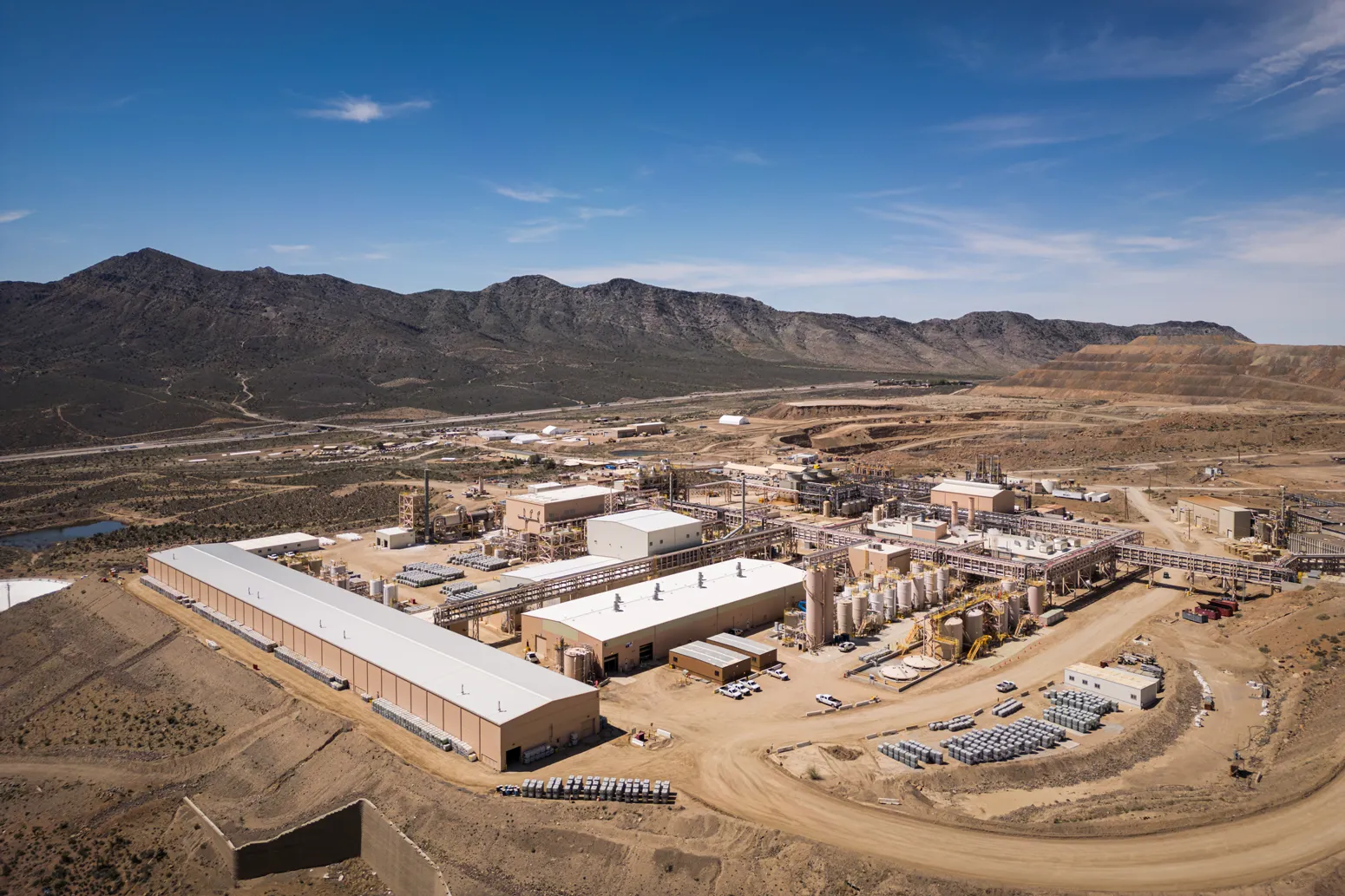
Mountain Pass mine and processing facility, San Bernardino County, California. Photograph: MP Materials.
What SX is good at
- Continuous, around the clock
- Scales to tens of thousands of metric tons a year
- Simple equipment: a tank, an impeller, a weir
- Industrial since the 1960s; every operating plant
- Cheap per stage, indifferent to stage count
What it costs
- Large inventory of flammable organic
- Acid and caustic by the tanker
- Hundreds of stages, a building full of tanks
- Weeks to reach steady state after a stop
- Solvent losses and degradation to wastewater
- Hardest, most stages, at the heavy end
What chromatography is good at
- Many stages per meter of column
- No organic: water, acid, ligand only
- High purity from one column, one pass
- Small footprint; buildable in modules
- Biotech resin engineering to borrow from
What it costs
- Cyclic, not continuous (moving bed helps)
- Throughput set by kg per m³ of resin per day
- Resin bought by the liter, replaced when fouled
- Ligand consumed unless recovered
- Iron, aluminum, thorium compete for the beads
- Product leaves dilute, in ligand solution
| Solvent extraction | Chromatography | |
|---|---|---|
| Stages per meter | few | many |
| Reagents | organic, acid, caustic | water, acid, ligand |
| Purity per pass | one split per cascade | several elements per column |
| Footprint | a building of tanks | a room of columns |
| Choose your cuts | yes, one per cascade | no, the whole train arrives |
| Continuity | continuous | cyclic; moving bed helps |
| Proven scale | tens of thousands of metric tons a year | pilot, kilograms to metric tons |
| Track record | every operating plant | 1950s pilot; 2020s pilots |
| Cost per kg at scale | not published | not published |
| Family | What selects | Shown, in public |
|---|---|---|
| Supported liquid membrane | extractant in the pores | lab; Nd/Dy ≈ 2.4 on 4 cm²; organic washes out |
| Membrane solvent extraction | extractant in the pores, fed continuously | 40 m² skid, 300 kg/mo mixed oxide from scrap; Dy from NdPr at 0.31 g/m²/h |
| Polymer inclusion membrane | carrier bound in the polymer | lab; Ce/La ≈ 2.8, Yb/Lu ≈ 3.8, Y/Ho ≈ 1.3; 5–10 cycles |
| Imprinted / framework | a cavity shaped for one ion | lab; Tb/Nd and Dy/Nd ≈ 11 in a four-ion mix; bench only |
| Nanofiltration | charge and size, no carrier | rejects all rare earths at 92–96%; no selectivity between them |
| For comparison | SX, PC88A | Nd/Pr ≈ 1.4 per stage; plants of hundreds of stages |